


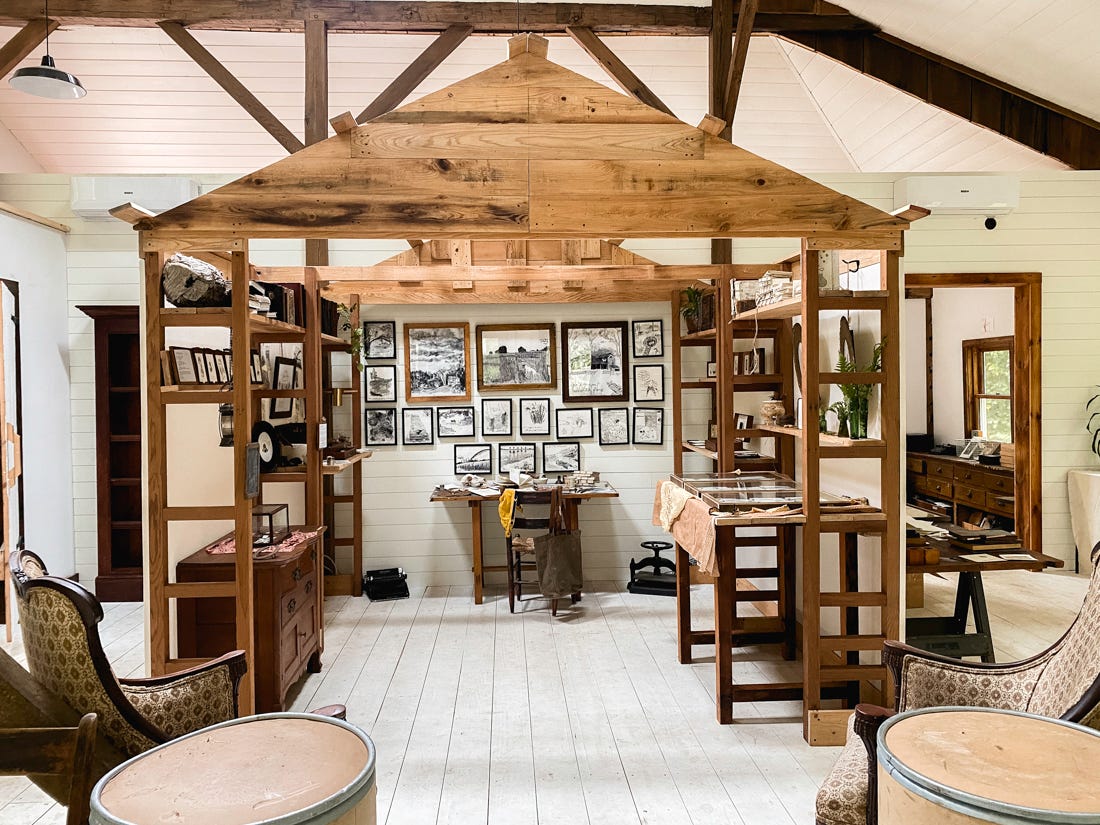
SMUDGE and Other Pandemic Pages
“If you like to write or draw or dance or sing, do it because it’s great: as long as we’re playing around like that, we don’t feel lonely, and our hearts warm up.”
Clarice Lispector from The Woman Who Killed the Fish
I’ve been making books and filling them for as long as I can remember. The books pile up — a slow and steady drip of ink on paper that may someday push us out of our home. One of the gifts of the pandemic is a distinct time frame. I’ve decided to go back into my journals, specifically, into the pandemic pages, to see what I could find. I found the patterns of our lives on repeat, everything obsessively documented as if we couldn’t live without record of it. I found Pearl and plants, grief and illness, disappearance and disappointment, homeschooling, camping, movement, and details so small I needed the quiet of a pandemic to experience them. It is a strange vocation, to be this kind of capturer of the quotidian.
“What is the conversation?” asks Claire, a few times. Conversation? I don’t know how to answer that. The conversation is on the pages, extracted from life, fragments rearranged, stories imagined, reimagined. Patterns, tatters. Is there ever an actual anything, or is everything imagined? There isn’t a conversation — there are infinite conversations and there are no conversations. It depends on who stands in front of what, and where. It depends on who is next to them. How engaged they are. How curious. It depends on what I say here, if anything, and whether you read it. Will you?
Just before the pandemic, I chose a word for the year, for 2020: The word was lightness. I wrote:
“My word for the year is lightness. I love this idea of finding a word to live alongside. So far, (so early but so far) it has freed me from the fear of not making the right marks. It has led me to say yes to a wintry adventure at the seashore where with wet knees and raisoned fingers, we searched for Cape May diamonds with the enthusiasm of children, whilst the actual children played with drones, dipped their feet (and pants) into the frigid water, gathered a few specimens, and made their way back to the warm car. These are things that I love, but the weight of obligation and difference and the world’s expectations make it difficult to be so light. The more I forget this, the longer I sit. The longer I sit, the heavier I get, the weight of dust settling upon me. Lightness. The word, my companion, reminds me to hover and to float— to move and to keep moving.
It was the right choice, this word, and it came just in time.
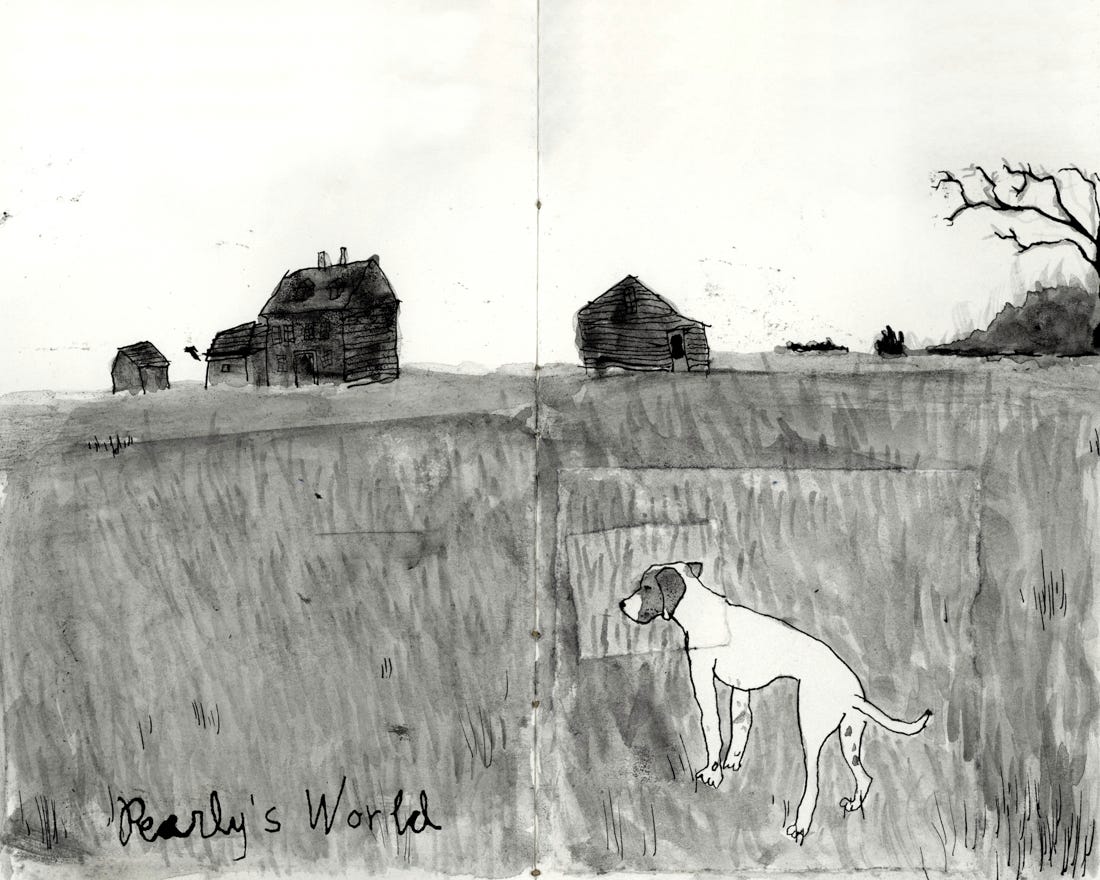
SMUDGE volumes 1 - 6 non-dominant hand journals
Paper, thread, ink 2021-2023
I started a new journal that I call Smudge. In it, I use my left, non-dominant, hand. It is a journal where drawings dominate the pages and words accompany them. It was meant to last for 100 days, but then, I generally don’t mind a Thing’s End – for then another begins. This is not the case with my left-handed project. I must find a way to continue. I feel no drudgery here on day 88. In the end, I made six volumes containing nearly six-hundred drawings over the course of two years. The left hand is connected to the same body as my right, but I am hard on this familiar creature. The left hand requires a kind of nurturing and patience that I do not give most things. I am delighted and uncritical of the pages, as if they are each a gift to me, from this Other who is also my self.
“I don’t love Smudge” wrote Katie. “It is so negative, and I see your work as being a collection of wonderments and curiosity.” When I consult the dictionary, I, too, am disappointed. There are no definitions of the word Smudge that give lightness and movement and mystery to the word as I see it. “I’ll add a definition then.”
smudge
[ smuhj ]
verb (used with object), smudged, smudg·ing.
x. a soft or blurred edge of a mark, object, or being.
Like pencil scribbled measurements on the inside of an old drawer, or the endlessness of wobbly stitches that make old quilts more alive than new ones, the smudge allows me to embrace the imperfections and the mess and truth of life. Like the unself-conscious marks of a child’s drawing, the smudge captures the essence of a moment, the small details of marks left in the act of life that often go unnoticed or hidden or covered or erased. I am particularly tuned into the smudge as it offers evidence of humanness in a world that is made feverishly faster and tidier with machines. Whilst I am no luddite and welcome change and efficiency of many kinds, I don’t want to lose the Smudge, the evidence of my existence on my pages. Smudge.


The thought that a smudge of left-handedness might exist in me is something that intrigues me. I recall that, as a child, I frequently found it difficult to decide whether or not to use my right or left hand (or my right or left foot). Drawing upside down helps to concentrate on marks rather the whole image, so what would using my left hand bring to my art? Making marks is constantly on my mind. I scour boot sales, charity shops, antique/vintage/junk shops for tools that will add that little ‘smudge’ that will enhance my work. Thank you for making me ponder.
What a beautiful text and experience, I don't usually read many newsletters, but yours always attracts me! It left me thinking about the current paradigm that values certainties, as if doubt, stains, marks of time are something bad and everything has to be ultra programmed and calculated for maximum efficiency and competition.